
If a fix-and-flip deal shows a projected $100,000 profit, it must be a great deal, right?
Not necessarily.
One of the biggest mistakes we see real estate investors make is focusing on the potential profit without taking a close enough look at the capital, timeline, and risk required to earn it.
An experienced investor doesn’t just ask:
“How much can I make?”
They ask:
“Does this deal still work if something goes wrong?”
That distinction matters whether you’re flipping a house in Charleston, SC, renovating an investment property in Greenville, SC, or looking at a fix-and-flip opportunity in Asheville, NC or Savannah, GA.
Profit Is Only One Part of the Equation
Let’s say you’re looking at a property that appears to offer a $100,000 profit after the renovation.
Sounds great.
But what if you need $300,000 of your own cash tied up in the project? What if the renovation takes nine months instead of six? What if your contractor uncovers $20,000 in unexpected repairs? What if the after-repair value comes in lower than expected?
That $100,000 projected profit starts to look a little different.
This is why experienced real estate investors look at more than the bottom-line profit. They consider return on capital, project timeline, financing costs, construction risk, and the potential exit strategy.
A smaller profit on a short, straightforward project can sometimes be a better investment than a much larger projected profit on a complicated project with significant risk.
What Happens If Rehab Costs More?
Every experienced flipper knows that renovations rarely go exactly according to plan.
There may be electrical problems behind the walls. Plumbing may need to be replaced. A contractor may discover structural issues. Materials may cost more than expected. Permitting may take longer.
That’s why your rehab budget matters just as much as your purchase price.
Before taking on a fix-and-flip investment, ask yourself:
- What happens if construction costs 10% more?
- Do I have enough reserves to handle an unexpected expense?
- Does the project still make sense if the timeline gets extended?
- Is there enough margin between my total project cost and expected sales price?
If your deal only works when everything goes perfectly, that’s a warning sign.
Don’t Get Too Comfortable With Your ARV
Another common mistake is relying too heavily on an optimistic after-repair value (ARV).
It’s easy to look at the best comparable sale in the neighborhood and assume your finished property will achieve the same price.
But what happens if the market shifts?
What if your finished product doesn’t command the premium you expected?
What if your property sits on the market longer than anticipated?
A conservative investor doesn’t simply ask, “What could this property sell for?”
They ask, “What is a reasonable value, and how much room do I have if I’m wrong?”
That’s particularly important in competitive markets throughout South Carolina, North Carolina, and Georgia, where neighborhood-level conditions can vary significantly from one property to the next.
Time Is Another Cost
A lot of investors focus on the purchase price and rehab budget but underestimate the cost of time.
Every additional month on a project can mean additional:
- Interest
- Property taxes
- Insurance
- Utilities
- Maintenance
- Contractor costs
- Marketing and selling expenses
A flip projected to take six months can become a very different investment if it takes nine or twelve months to complete and sell.
That’s why your fix-and-flip financing should be evaluated alongside your overall project timeline and exit strategy.
The Insider Tip: Stress-Test Your Deal
Here’s the approach experienced investors use:
Don’t just run the numbers on the best-case scenario.
Run the numbers on the worst reasonable scenario.
What happens if:
Rehab: +10%
ARV: -5%
Timeline: +3 months
Sale: Takes longer than expected
Does the deal still make sense?
You don’t need every possible scenario to produce the same return. But you should know exactly how much room you have before a small problem becomes a major one.
That margin is what can turn a risky deal into a manageable one.
A $20K Flip Can Be Better Than a $100K Flip
Consider two hypothetical projects.
Deal A:
- $20,000 projected profit
- $40,000 of investor cash required
- Four-month timeline
- Straightforward renovation
- Relatively low construction risk
Deal B:
- $100,000 projected profit
- $300,000 of investor cash required
- Twelve-month timeline
- Significant renovation risk
- More uncertainty around the exit
At first glance, Deal B looks like the obvious winner.
But profit alone doesn’t tell the whole story.
The investor in Deal A may be able to turn that capital over several times while the investor in Deal B has a significant amount of money tied up in one project.
The bigger profit isn’t always the better return.
Where Financing Comes Into Play
The right private lender or hard money lender can be an important part of a successful fix-and-flip strategy.
Fix-and-flip financing can allow investors to leverage their capital rather than putting all of their available cash into the acquisition and renovation. But financing doesn’t make a bad deal good.
You still need to understand:
- Your total acquisition and renovation costs
- Your financing costs
- Your projected ARV
- Your expected selling costs
- Your timeline
- Your available reserves
- Your realistic profit margin
At Low Tide Private Lending, we work with real estate investors across South Carolina, North Carolina, and Georgia, helping investors evaluate financing for fix-and-flips, bridge loans, cash-out refinances, and other investment-property opportunities.
Our primary markets include Charleston and the South Carolina Lowcountry, Greenville and the Upstate, Columbia, Western North Carolina including Asheville, the Raleigh-Durham area, and the Savannah, Georgia market.
Because ultimately, good lending isn’t just about getting a loan closed.
It’s about understanding the deal behind the loan.
The Bottom Line
The next time you find a property with a projected $100,000 profit, don’t immediately ask how quickly you can get it under contract.
Take a step back.
Ask:
How much cash am I putting into this deal?
How long will that money be tied up?
What happens if rehab costs more?
What happens if my ARV is lower?
What happens if the property takes longer to sell?
And most importantly:
Does the deal still work when things don’t go according to plan?
That’s the difference between simply finding a deal and actually underwriting a good investment.
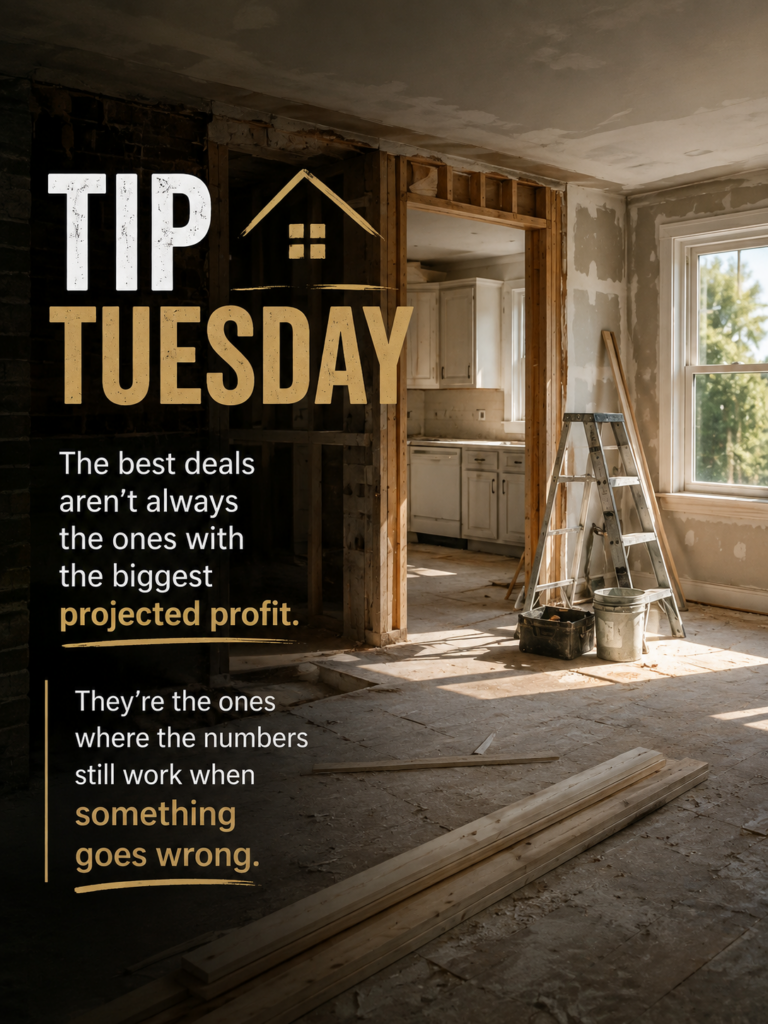
Because the best fix-and-flip deals aren’t always the ones with the biggest projected profits.
They’re the ones where the numbers still work when something goes wrong.
Looking for Fix-and-Flip Financing?
If you’re an investor looking for a hard money lender or private lender in South Carolina, North Carolina, or Georgia, Low Tide Private Lending can help you evaluate your financing options.
We work with real estate investors throughout Charleston, Greenville, Columbia, the South Carolina Lowcountry and Upstate, Asheville and Western North Carolina, Raleigh-Durham, and the Savannah, Georgia area.
Have a deal you’re evaluating? Let’s talk numbers.